
MUSE: the bloodline is the difference
A dispatch from inside the House’s most elemental world.
There is a word that circulates too freely in this category. Fullblood. It is used - sometimes loosely, sometimes incorrectly - as a signal of maximalism. More fat. More intensity. More of whatever the market currently rewards.
MUSE is fullblood. But the word is not the point. The bloodline is.
One hundred percent Japanese genetics. No crossbreeding. No compromise in the pedigree. Every animal genetically verified and registered through the Australian Wagyu Association. Every generation traceable - back through the breeding records, back through the import history, back to the foundation animals from the Hyogo region of Japan.
Those names - Tajima, Hyogo - are not decorative provenance. They are the genetic architecture of what marbling is. The Tajima cattle of the Hyogo prefecture were selected, for generations, for exactly the traits that make MUSE what it is: the fineness of intramuscular fat distribution, the specific way the fat is laid down in the muscle, the particular dissolution on the palate. The genetics that produce that outcome did not appear on Australian soil by accident. They were brought here, registered, and bred with a specific purpose.
MUSE exists because someone made a long series of deliberate decisions about which animals to put together and why.
Those decisions continue. Genomics are used to predict marbling scores before an animal reaches the feedlot - not to guarantee a result, but to stack the probability in the direction the program has been refining for years. Sire and dam selection is data-driven: fat distribution, marbling fineness, the specific traits that define the eating experience. Every pairing is a choice, not a chance.
The breeding program is housed in Southern Australia - in country chosen not for convenience but for what the climate and pasture quality contribute to the starting point of the animal. Fullblood Wagyu at this level responds to its environment. The island conditions that produce a particular focus and refinement in the cattle are not incidental to MUSE - they are, in a real sense, part of it.
The grain program runs to 450 days. Not because 450 is a number we settled on, but because fullblood genetics at this level need the time to express themselves fully. Rushing the program produces a result. It does not produce MUSE.
What this means at the table is something that is easier to experience than to describe, but a chef who pays attention will recognise it.
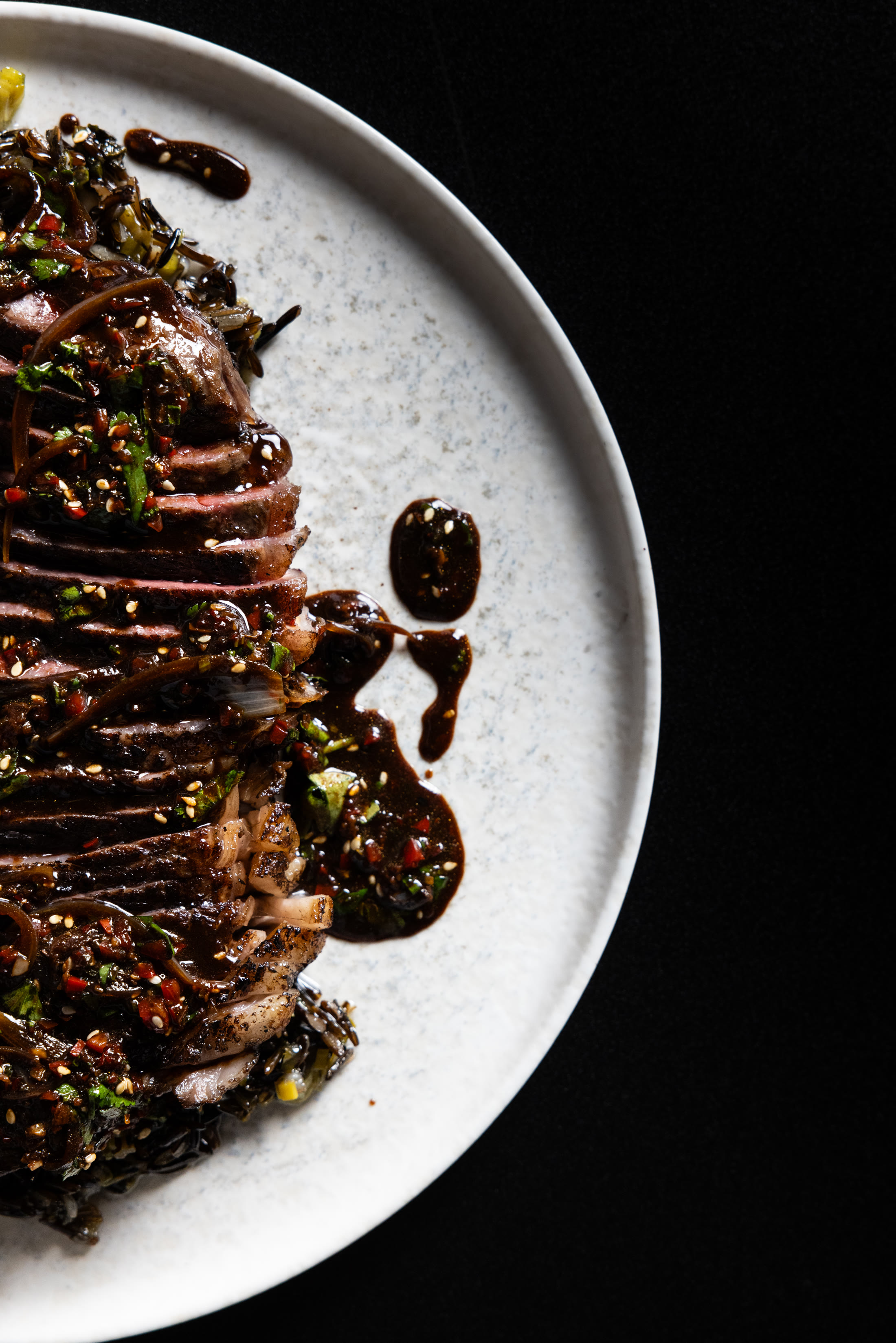
The marbling is extraordinary - MB6 through MB9 and above. But the marbling score is the beginning of the description, not the end. What MUSE does is distribute that fat with a fineness that produces a specific quality of melt: slow, even, beginning before the surface has fully coloured, releasing layers of sweetness and umami in a sequence that extends through the finish and does not become heavy. The texture is extraordinary - yielding without the softness that can make an over-marbled product feel indulgent rather than precise.
It does not ask for technique. It asks for respect and heat applied with care. MUSE does not need to be rescued by a dish. It is the dish.
Every animal that achieves the highest grades qualifies for MUSE. The rest - no matter how close - do not carry the name.
Processing is carried out at G&K O’Connor’s accredited facility. Halal certified. Cryo-vacuum sealed.
This is a dispatch, not a specification. The specification is on the MUSE page, for those who need the numbers. This is for the person who wants to understand what the bloodline actually is - and what that word, fullblood, requires before it means anything.
If MUSE belongs on your menu, or in your portfolio, the conversation begins at the contact page.